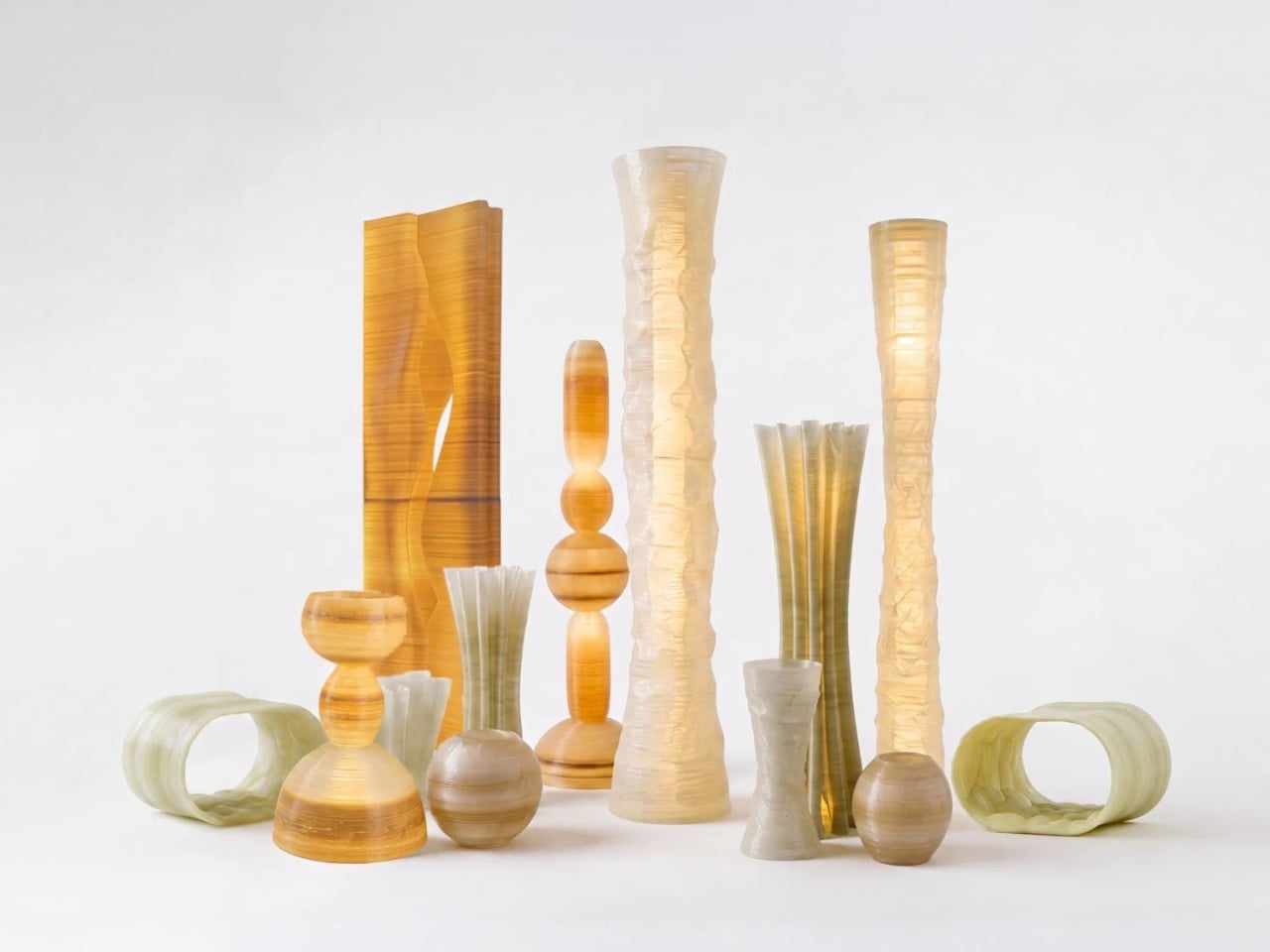
That’s the quiet waste problem three Taiwanese designers decided to tackle, and their answer isn’t a compost bin or a recycling app. It’s furniture, lighting, and sculpture made from the very stuff most of us scrape into the trash without a second thought. The project is called After the Last Sip, and it turns discarded tea leaves from London’s bubble tea shops and used coffee grounds from local cafés into large-scale 3D-printed objects.
Designers: Chao-Chun Kung, Ching-Yu Lin and Chen-Yang Chang
The team behind it, Chao-Chun Kung, Ching-Yu Lin, and Chen-Yang Chang, worked out of Fab.Pub in East London, where they dried and ground the collected residues, then mixed them with PLA, a biodegradable polymer, to create a printable composite. From there, robotic 3D printers built the material into shapes designed through parametric systems, meaning the geometry itself grows out of code as much as it does out of leftover tea and coffee. The whole thing shows during the London Design Festival, running September 12 through 18.
What I like about this project is that each designer treated the same basic waste stream as a completely different kind of material. Kung’s piece, CHA, leans into Taiwan’s tea culture directly, building its form around a parametric system derived from the Chinese character for tea itself. Lin’s Undetermined Shore uses coffee-ground composites to create layered, sediment-like surfaces that echo Taiwan’s shifting coastline, which is a clever way to make a cup of coffee feel geological. Chang’s Nexus Bloom pushes the tea-waste composite into continuous, flowing parametric forms that feel closer to something grown than something printed.
None of these pieces try to hide what they’re made of. That’s the part that actually sold me on the whole idea. So much sustainable design ends up disguising its origins, smoothing away anything that might remind you it used to be trash. After the Last Sip does the opposite. The printed layers stay visible, the particles show through, the surfaces stay irregular and a little rough in places. You can see the tea leaves and coffee grounds sitting right there in the material, not hidden under a coat of paint or a clever finish.
I think that honesty is actually the point. A lot of us drink our coffee and tea on autopilot, never really registering that we’re generating a small pile of organic waste every single day, forever, without thinking twice about where it lands. Seeing that same waste reappear as a sculptural object or a light fixture forces a tiny recalibration. It’s the same material, just given a second job instead of a one-way trip to landfill.
I won’t pretend every object here looks effortless. Some of the surfaces are clearly still experimental, and you can tell the designers are working through what this composite can and can’t do at scale. But that rough edge is part of what makes the project feel real rather than staged for a trend piece. It reads like genuine material research, not a marketing stunt dressed up as sustainability.
Design festivals produce a lot of noise every year, plenty of it forgettable within a week. This one has staying power because it doesn’t ask you to buy anything or change your habits overnight. It just asks you to look at your empty coffee cup differently for a second, and that’s a small shift I can get behind.
The post Coffee Grounds and Tea Leaves Finally Become Art first appeared on Yanko Design.
https://www.yankodesign.com/2026/09/04/coffee-grounds-and-tea-leaves-finally-become-art/