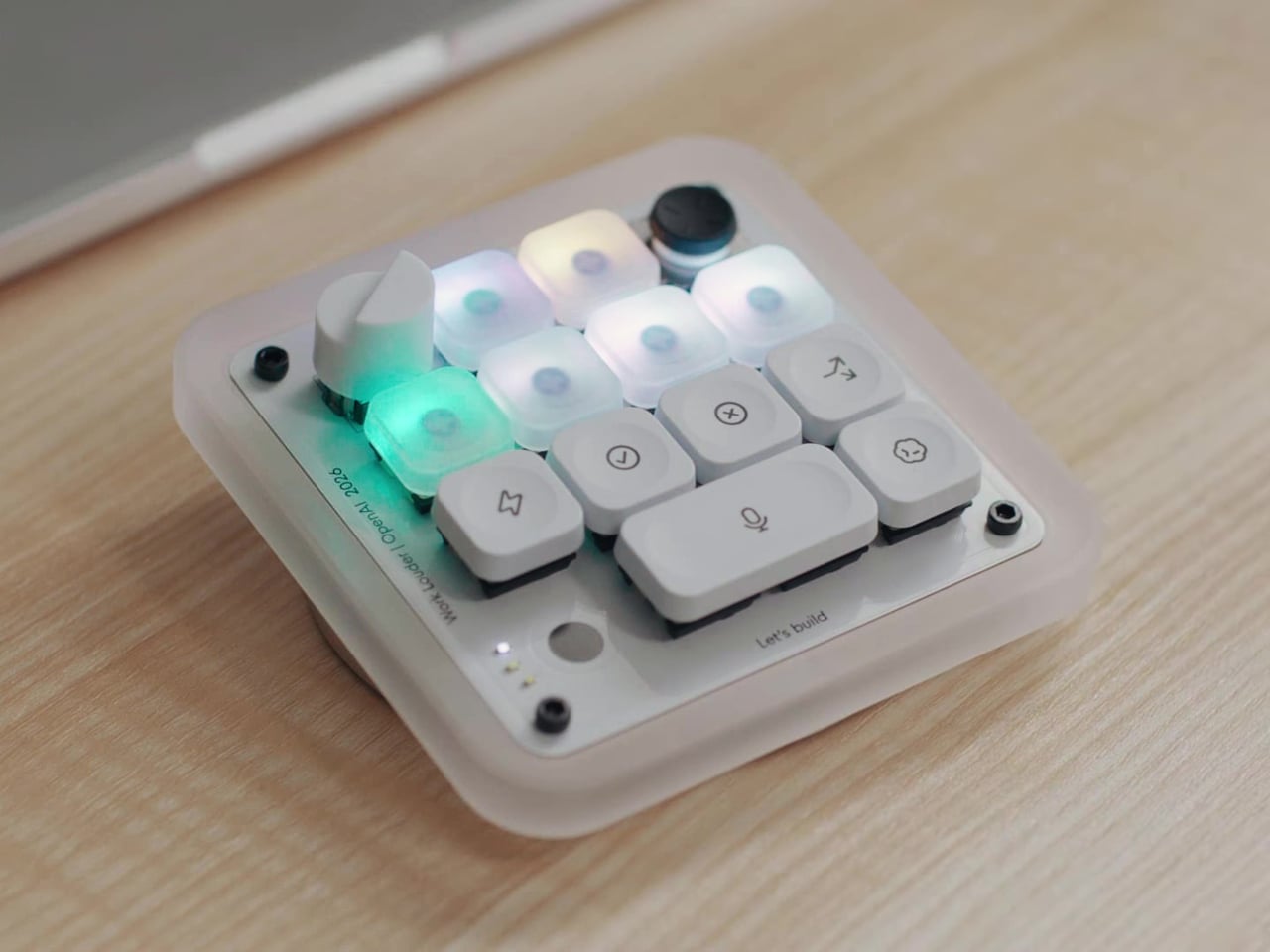
That’s the problem the Codex Micro, a collaboration between OpenAI and boutique keyboard maker Work Louder, tries to solve. It’s essentially a compact mechanical macropad purpose-built as a physical command center for AI agents, keeping the most important controls and status readouts within arm’s reach without requiring you to look at your screen. It’s a small but thoughtfully considered piece of hardware for heavy Codex users.
Designer: Work Louder x OpenAI
The heart of the device is its six frosted Agent Keys, each mapped to a separate Codex thread. They light up in different colors to reflect each agent’s status: white for idle, blue for thinking, green for completed tasks, amber when it needs your input, and red for errors. A single tap selects an agent in the background; a double tap brings it to the foreground.
The dial and joystick add two more dimensions of tactile control. The rotary encoder lets you adjust how deeply your agent reasons through a problem, dialing things down for quick tasks and up when the work calls for more careful consideration. The four-directional joystick can be mapped to skills like toggling plan mode or navigating between threads, and it’s never more than a thumb’s flick away.
The largest button, which takes up twice the space, is for push-to-talk. A double-tap starts recording, and the ambient RGB shifts to a snaking green pattern to confirm it’s live. Once you stop speaking, a white effect takes over while Codex processes your voice, and a solid white cue signals it’s ready to send. It makes submitting a prompt feel more like dictating than typing.
Beyond what it does, the Codex Micro is built to feel as good as it works. The body is made from sandblasted polycarbonate that diffuses the RGB lighting into a soft, even glow. The base, a solid aluminum block, keeps the whole unit planted on the desk thanks to an anti-slip ring. Buyers can choose between clicky or silent low-profile switches, with USB-C and Bluetooth connectivity.
What sets it apart from a generic programmable macropad is its direct integration with Codex itself. There’s no extra software to download or vet; key assignments and layouts can be adjusted natively within Codex. For more advanced setups, Work Louder’s Input app unlocks up to six programmable layers, letting you group different workflows into dedicated layouts without needing more desk space. It works on both Mac and Windows.
The Codex Micro ships with a USB-C to USB-C cable and the Codex Icon Keyset, a collection of 32 custom-designed keycaps with icons specific to Codex functions. It’s the kind of peripheral that’ll appeal to developers who’ve started treating their AI agents less like chat windows and more like teammates running parallel tasks. It’s priced at $230, and stocks have been limited since its launch.
The post OpenAI and Work Louder Just Built a $230 Physical Remote for AI Agents first appeared on Yanko Design.
https://www.yankodesign.com/2026/07/20/openai-and-work-louder-just-built-a-230-physical-remote-for-ai-agents/